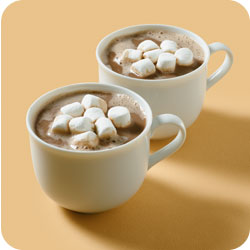
Although it hasn't snowed yet, we all know it is right around the corner. Just think about a brisk and chilly winter morning when you wake up to find that the earth is covered in a fresh blanket of fluffy white snow. You groggily get out of your warm bed and pull on your snow pants, boots, jacket, and mittens, grab the shovel and head out the door. You shovel the drive way for a good half and hour, your nose turns red, your fingers feel as if they might fall off but yet you enjoy the beauty of the snow. After the time in the chilly weather and all the hard work of hauling the snow off of the drive way you decide to head in and have a nice warm and delicious mug of hot chocolate topped with marshmallows and whipped cream before heading back out to enjoy the snow by sledding down the big hills covered in slick snow. But where did this delicious drink that keeps you toasty warm in the winter come from?
It is believed that beverages containing chocolate date all the way back to the Aztecs. Cocoa beans were very valuable to the Aztec people and were used for cooking and currency as well as being given as gifts. These cocoa beans could be used to make a chocolatey drink, but this drink was very unlike our modern hot chocolate. For one, it was served cold and it was flavored with wine and peppers giving it a bitter and not sweet taste. When chocolate was discovered by Spainsh explorers in the 1500's it was introduced to Europe. There hot chocolate was changed. It was served hot and had a sweet flavor as it was no longer flavored with spicy chili peppers. It wasn't until the 1700's that this drink reached Britain where they started to add milk for flavoring and it became a nice and popular after dinner treat. Finally in the 1800's cocoa powder was invented. This powder was a lot easier to mix in with the water or milk and most likely made hot chocolate a much quicker and easier treat to make and enjoy.
Although it has changed a lot from its origins hot chocolate is a great treat that keeps you nice and toasty during the chilly winter months and always puts a smile on your face when you are enjoying a nice sweet mug of it.
Information from:
http://coffeetea.about.com/cs/chocolate/a/chochistory.htm
http://en.wikipedia.org/wiki/Hot_chocolate#History
Picture from:
http://www.sogoodblog.com/wp-content/uploads/2010/10/hot-chocolate.jpg
Thursday, December 15, 2011
Wednesday, December 14, 2011
Ruldolph the Red-Nosed Reindeer
You know Dasher and Dancer, and Prancer and Vixen, Comet and Cupid, Donner and Blitzen, But do you recall the most famous reindeer of all? Of course you do! :) Everyone knows Rudolph the red-nosed reindeer. I personally look forward to watching this Christmas special every year and would definitely say that it is one of my favorites. Earlier today I was trying to think of a Christmas idea to blog about and after a little while I thought of Rudolph the red-nosed reindeer and wondered where the story of this fun little reindeer who saves Christmas came from. Rudolph was created in 1939 by Robert Mays, a copywriter for Montgomery Ward in Chicago. The company wanted to come up with a Christmas pamphlet to hand out to the customers around Christmas time in order to increase the number of people coming to the store and of course to make money. The store was known to hand out coloring books around this time of year but the pamphlet idea was a way to save money. Robert Mays had experience with writing children's stories and poems, so this made him the right man for the job!
Robert Mays decided to write a story about a reindeer that was different from the others and picked on because of his red nose. Before deciding to name the reindeer Rudolph he had considered the names of Rollo and Reginald. The story was written in couplets and had a poetic feel. Mays would read the story as he was working on it to his young daughter to make sure that it would appeal to children. The story was really coming together but May's boss was a little worried about Ruldolph having a red nose due to a red nose being associated with drinking. Mays responded by having a friend draw up a picture of this thought up character. No one could resist this Christmas character and the story was approved by Mays boss. 2.4 million copies of this story were sold just by the end of 1939 alone!
The song "Rudolph-the-Red-nosed-Reindeer" was created in 1949 by Robert Mays brother in law, Johnny Marks and was recorded by Gene Autry. The song sold 2 million copies in the fist year alone.
The tv show that we all know and love first aired in 1964. Somthing that I was suprised to learn was that the characters Yukon Cornelius (silver and gold guy), Clarice (the girl reindeer with the bow who likes ruldolph), and Hermey (the elf who would like to become a dentist) were all new characters added to the special that were not in the book. The scenes about the Island of misfit toys as well as the scene where Rudolph rescues his parents and friend from the abominable were also new to this special.
Although the story may have started out just being a store way of attracting customers, Rudolph is still one of the most popular Christmas specials today that is loved and watched by both kids and adults alike.
Info from:
http://www.snopes.com/holidays/christmas/rudolph.asphttp://en.wikipedia.org/wiki/Rudolph_the_Red-Nosed_Reindeer
http://www.the-north-pole.com/carols/rudolph.html
Picture from:
Sunday, December 11, 2011
Dog of the Week: Saluki
The Saluki is a very graceful medium to large sized dog that weighs around 31 to 60 pounds. They stand anywhere from 21 to 28 inches off of the ground and have a life expectancy of about 10 to 12 years. The Saluki is a very long and slim dog. They have a long and slim face, a long neck, a long and slim body, as well as a long and slim tail. Saluki's have ears that hang down by the side of their face and large oval shaped eyes. These dogs are pretty similar to grey hounds. They can come in two coat varieties, either a short coat with long, feathering hair around the ears, legs and tails or a short coat that has no feathering. They can be a variety of colors including white, fawn, red, black, white, cream, tan, gold or a mixture of colors.
The saluki is a very old breed of dog that is thought to be related to the Afghan hound and is native to the Turkey area. In Egypt the Saluki was known as a royal breed and is one of the oldest domesticated breeds known. The name of the dog derived from an ancient Middle Eastern city that no longer exists. Salukis were recognized by the AKC in 1927.
The Saluki is a very active dog and would need an owner willing to put in a fair amount of time training it and who lives an active lifestyle that the dog could be a part of. These dogs need a large fenced in yard to run around in. These dogs can run up to 35 miles per hour so it is important to either have them inside the fence or on a leash because they tend to run after things due to hunting instinct and can be hard to catch. It is also important to make sure the fence is high enough because these dogs are very good at jumping as well and could probably hop over a 5 foot fence. These dogs can be hard to train but if you have patience and put the time that is necessary in you can have a well trained dog. These dogs are very gentle and will have a great and loving relationship with their owners. Being a very active and intelligent dog, the Saluki can do very well at sports like flyball, agility, racing, and tracking. After running around all day the Saluki will love to sleep in their owners bed and are very fond of curling up in the pillows and blankets. Salukis can do well with children and some cats, but are not recommended to be with small rodents again due to their hunting instinct. These dogs are average shedders and just need the occasional brushing, bath, and ear cleaning. The Saluki is a very active and sweet dog a nd would make a great addition to an active family.
Info from:
http://www.dog-breed-facts.com/Breeds/saluki.html
http://www.dogbreedinfo.com/saluki.htm
http://www.justdogbreeds.com/saluki.html
Picture From:
http://www.greatdogsite.com/photos/gallery/Saluki/?index=7
The saluki is a very old breed of dog that is thought to be related to the Afghan hound and is native to the Turkey area. In Egypt the Saluki was known as a royal breed and is one of the oldest domesticated breeds known. The name of the dog derived from an ancient Middle Eastern city that no longer exists. Salukis were recognized by the AKC in 1927.
The Saluki is a very active dog and would need an owner willing to put in a fair amount of time training it and who lives an active lifestyle that the dog could be a part of. These dogs need a large fenced in yard to run around in. These dogs can run up to 35 miles per hour so it is important to either have them inside the fence or on a leash because they tend to run after things due to hunting instinct and can be hard to catch. It is also important to make sure the fence is high enough because these dogs are very good at jumping as well and could probably hop over a 5 foot fence. These dogs can be hard to train but if you have patience and put the time that is necessary in you can have a well trained dog. These dogs are very gentle and will have a great and loving relationship with their owners. Being a very active and intelligent dog, the Saluki can do very well at sports like flyball, agility, racing, and tracking. After running around all day the Saluki will love to sleep in their owners bed and are very fond of curling up in the pillows and blankets. Salukis can do well with children and some cats, but are not recommended to be with small rodents again due to their hunting instinct. These dogs are average shedders and just need the occasional brushing, bath, and ear cleaning. The Saluki is a very active and sweet dog a nd would make a great addition to an active family.
Info from:
http://www.dog-breed-facts.com/Breeds/saluki.html
http://www.dogbreedinfo.com/saluki.htm
http://www.justdogbreeds.com/saluki.html
Picture From:
http://www.greatdogsite.com/photos/gallery/Saluki/?index=7
Saturday, December 10, 2011
Animal Crackers
Everyone probably remembers being a little kids and having our parents hand us a little bright red box of animal crackers to snack on. The box alone was fun, decorated with bright colored circus animals. After admiring the animals it would be time to rip the box open (no longer worried about the box, but anticipating what delicious little animal crackers were inside). You then would reach in and see what animals you had. Ripping one out you would proudly declare to others around that you had a bear or a camel. It was now time to bite off the head of the cracker and giggle like all little kids do because they find it funny that they now have a headless animal cracker. Many memories are made while eating animal crackers. Shaping baked goods into little animal shapes was thought to be a popular Christmas tradition in medieval Germany. These treats would often be used as Christmas decorations and were highly thought of. By the nineteenth century animal shaped cookies started to be produced in factories and were very popular in England.
It was also during this time that animal crackers were shipped over to America from England where they were a huge hit and were soon being produced by American bakeries. The National Biscuit company (known as Nabisco today) was one company that produced these popular treats. In 1902 animal crackers became known as Barnum's Animal's and then started to take on the circus theme (from the Barnum and Bailey Circus). It was also during this year that the festive little red boxes were developed, before this they were only sold in the big containers and tins. These boxes however, were developed to be Christmas ornaments which is why they had a string attached to the top. These small snack size boxes were very popular and as you can tell caught on as they are still sold today, although back then each box was only 5 cents.
Animal crackers have been a huge hit for many years. They have featured 54 different animals including the tiger, camel, lion, rhinoceros, giraffe, and most recently the koala. Over 40 million packages of animal crackers are sold yearly in the United States and 17 other countries. No one can resist the yummy taste and fun time of eating a box of animal crackers. And who knows maybe they are even still used in some houses as fun Christmas tree decorations.
Info from:
http://www.foodtimeline.org/foodcookies.html#animal
http://www.foodreference.com/html/artanimalcrack.html
http://en.wikipedia.org/wiki/Animal_cracker#History
Picture from
http://starhilldesignstudio.com/starhillblog/?p=53
Tuesday, December 6, 2011
Egg Nog
When a lot of people think of the holidays they may think about the famous drink, egg nog. A mixture of eggs, sugar, cream, milk, and if chosen an alcoholic beverage that either makes you long for it or wrinkle up your nose in disgust. I personally am not a fan of egg nog, but I was curious to how it came to be because it is such a unique beverage. After doing some research here is what I found.....
It is thought that egg nog originated in Europe and during the 1600's was used to toast to one's good health. Egg nog was a drink that only high-ranked citizens had the priviege of having because both eggs and milk were very scarce at the time.
As the drink spread to places all over the world, people from different countries started to make their own variations. In America, colonists added rum to the drink because it was easily purchased from the Carribean in the triangular trade. American colonists had plenty of eggs and milk and therefore people from all social classes could enjoy it.
The drink continued to spread across the globe an was modified with different alcohols and even coconut milk in Puerto Rico. As egg nog spread it became a holiday tradition for many people.
Now that we know more of the history of egg nog, where did it get its unique name? In Old English the word "nog" refers to a strong beer. Colonists in America would also refer to thick drinks as "grog". Although it is not exactly clear where the name came from these words may of contributed to the name egg nog.
Egg nog has been around for many years and it continues even today to be a popular holiday drink that still continues to be modified with different flavors and ingredients.
Information from:
http://cocktails.about.com/od/history/p/egng_hstry.htm
http://whatscookingamerica.net/Eggnog.htm
Picture from:
http://www.rachaelray.com/recipe.php?recipe_id=1274
It is thought that egg nog originated in Europe and during the 1600's was used to toast to one's good health. Egg nog was a drink that only high-ranked citizens had the priviege of having because both eggs and milk were very scarce at the time.
As the drink spread to places all over the world, people from different countries started to make their own variations. In America, colonists added rum to the drink because it was easily purchased from the Carribean in the triangular trade. American colonists had plenty of eggs and milk and therefore people from all social classes could enjoy it.
The drink continued to spread across the globe an was modified with different alcohols and even coconut milk in Puerto Rico. As egg nog spread it became a holiday tradition for many people.
Now that we know more of the history of egg nog, where did it get its unique name? In Old English the word "nog" refers to a strong beer. Colonists in America would also refer to thick drinks as "grog". Although it is not exactly clear where the name came from these words may of contributed to the name egg nog.
Egg nog has been around for many years and it continues even today to be a popular holiday drink that still continues to be modified with different flavors and ingredients.
Information from:
http://cocktails.about.com/od/history/p/egng_hstry.htm
http://whatscookingamerica.net/Eggnog.htm
Picture from:
http://www.rachaelray.com/recipe.php?recipe_id=1274
Sunday, December 4, 2011
Christmas Cards
It's that wonderful time of year again. The time where we all throw on our best Christmas sweaters, the red ones, green ones, snowflake ones, and maybe even ones with reindeers and blinking lights. :) We then all pose in front of the big and beautiful Christmas tree to take a picture that will soon be sent to everyone that we know. When did people start to send Christmas cards? And why did they send them? Well, lets find out!
Christmas cards are over 100 years old and started in England. A Man named Richard Armour commented to his friend Sir Henry Cole that although he tries to send greetingsto everyone there are so many people to make contact with that it can be hard to talk to everyone, but he felt it was important to tell others to help those in need. Sir Henry Cole agreed and had another man named John Calcott Horsley paint a scene of a happy family and the needs of the poor being met. The cards all said "A Merry Christmas and a Happy New Year to You", the first Christmas card was complete. Henry Cole then sent these cards out, and although it is said that he did not send any cards the following year this idea caught on and became popular.
American's had to import their Christmas cards, which were now becoming more and more designed with Christmas shapes and pop-up figures until 1875. A German immigrant by the name of Louis Prang opened a lithographic shop and published the first Christmas cards in America. Although his first cards didn't feature a lot of traditional Christmas images, by 1881 he was producing over 5 million Christmas cards a year and they began to be a lot more "Christmasy".
Even 150 years ago people felt rushed and like they didn't have time to get everything done and tell everyone one things they want to say and so they developed a card to help get this done. Today, a time that has become even busier these cards still help us to stay in contact with friends and family all over the country.
Info from:
http://www.emotionscards.com/museum/xmas.html
Picture from:
http://www.zazzle.com/christmas_card_merry_christmas-137780764831090480
Christmas cards are over 100 years old and started in England. A Man named Richard Armour commented to his friend Sir Henry Cole that although he tries to send greetingsto everyone there are so many people to make contact with that it can be hard to talk to everyone, but he felt it was important to tell others to help those in need. Sir Henry Cole agreed and had another man named John Calcott Horsley paint a scene of a happy family and the needs of the poor being met. The cards all said "A Merry Christmas and a Happy New Year to You", the first Christmas card was complete. Henry Cole then sent these cards out, and although it is said that he did not send any cards the following year this idea caught on and became popular.
American's had to import their Christmas cards, which were now becoming more and more designed with Christmas shapes and pop-up figures until 1875. A German immigrant by the name of Louis Prang opened a lithographic shop and published the first Christmas cards in America. Although his first cards didn't feature a lot of traditional Christmas images, by 1881 he was producing over 5 million Christmas cards a year and they began to be a lot more "Christmasy".
Even 150 years ago people felt rushed and like they didn't have time to get everything done and tell everyone one things they want to say and so they developed a card to help get this done. Today, a time that has become even busier these cards still help us to stay in contact with friends and family all over the country.
Info from:
http://www.emotionscards.com/museum/xmas.html
Picture from:
http://www.zazzle.com/christmas_card_merry_christmas-137780764831090480
Thursday, December 1, 2011
Breed of the Week: The Chinese Crested
The Chinese Crested is a toy breed of dog that is usually less than 13 pounds and only stands about 9-13 inches of the ground. The Chinese Crested has a life expectancy of about 15-16 years. These dogs are very slim and find boned with a thin and curved tail. The Chinese crested can come in two coat varieties. They can be either hairless, and only have tufts of hair on their heads, tail, and feet, or the can come in the powder puff variety and be fully covered with fur. The fur of this breed is soft and can grow to long lengths. They can come in a variety of colors and patterns including: white, tan, brown, black, silver, spotted, and many more varieties.The Chinese crested is thought to have descended from African-wild dogs. Through trading between merchants and sailors these dogs made their way to cities all around the world. Chinese sailor's preferred small breeds of dogs and would often sail with the Chinese Crested aboard in hope that these dogs would help to get rid of the rats on the ship. In the 19th century the Chinese Crested started to show up in European art and in the late 1800's they were entered in Dog shows in America. The Chinese Crested was acknowledged by the AKC in 1991as a toy breed.
The Chinese Crested is a very playful and curious dog. They are a pretty active dog that loves to play with toys. These dogs become attached to their families and love to spend a lot of time with them. They are very friendly and do well in a family that has children as long as the kids are gentle. The Chinese Crested is very affectionate and will show a lot of love to its family including a lot of puppy kisses. These dogs can live in almost any environment from apartment to mansion because of their small size. They will also do well with a wide age of owners including elderly owners because due to their small size they can burn off most of their energy playing inside. Being that these dogs are pretty active they do need exercise in the way of playing, walks, or running around inside or outside. When these dogs are taken outside they need a coat in the winter to keep them warm and a t-shirt in the summer to protect their skin from sunburn.
Unless you are planning on entering your dog into dog competitions, this breed requires minimal grooming. It is a light shedder and requires a regular bath (maybe every 1 to 2 weeks) and brushing. The hairless type may require some lotion and sunblock to keep their skin moisturized and to protect their skin from the sun. It is important to keep their teeth healthy as well due to the Hairless Crested being born with missing teeth.
The Chinese Crested is a wonderful companion that will become an important member of your family.
Info from:
http://www.akc.org/breeds/chinese_crested/
http://www.dog-breed-facts.com/Breeds/chinese-crested.html
http://www.justdogbreeds.com/chinese-crested.html
http://www.fetchdog.com/learn-connect/dog-breed-center/c/chinese-crested-dog-hairless/Chinese-Crested-Dog-hairless/D/lcbreedfactcenter/P/1:5:51:503:5271/I/BR00005271?#famous
http://www.jayasdesignercresteds.com/chinesecrested.html
Picture from:
http://www.yourpurebredpuppy.com/buying/chinesecresteds.html
Subscribe to:
Posts (Atom)